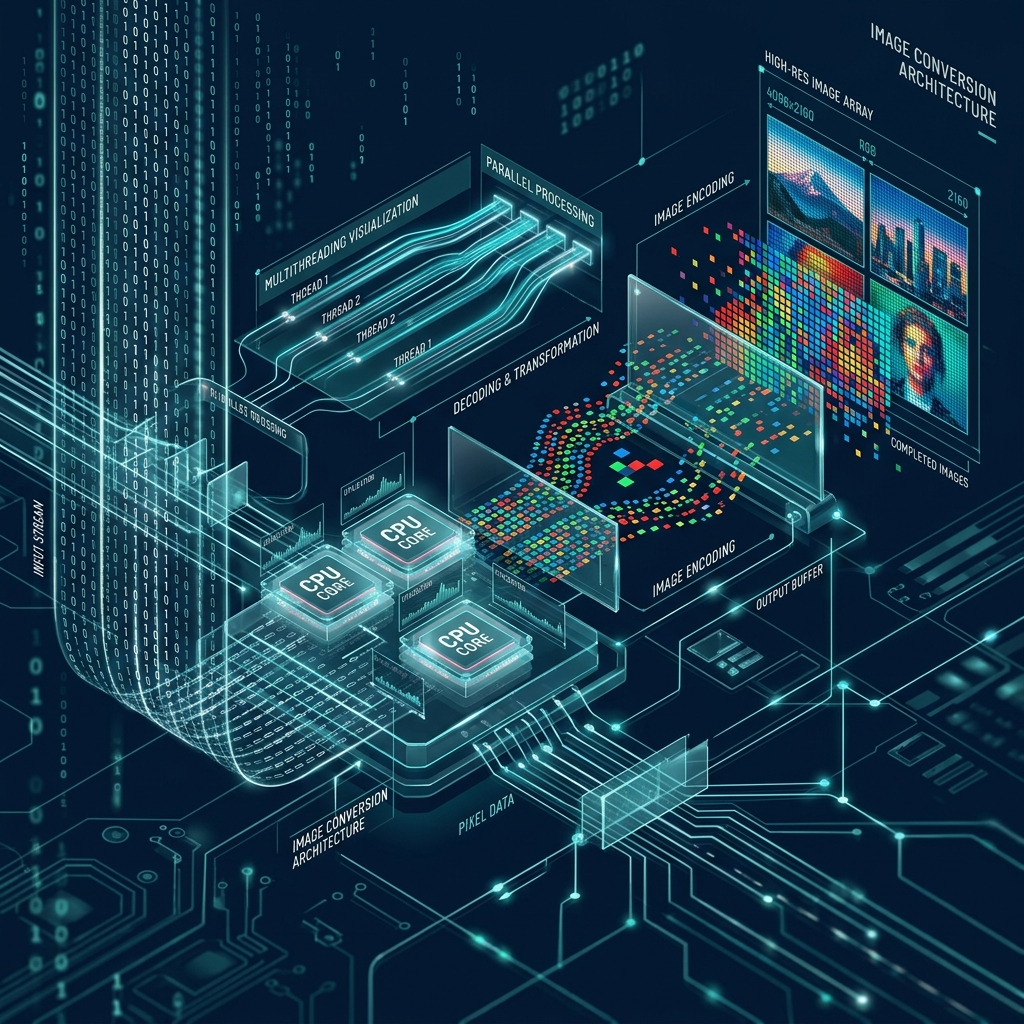
For nearly thirty uninterrupted years, the standard Baseline JPG was the undisputed, unchallenged king of the internet. It was a miracle of 1990s mathematics, allowing dial-up connections to transmit full-color photographs. But the internet of 2026 is vastly different. Today's web demands massive, immersive retina-quality imagery delivered in milliseconds over fluctuating mobile networks. In the mid-2010s, WebP arrived and started a much-needed revolution, proving that modern algorithms could beat the old standard by 30%.
Today, the revolution is continuing at a blistering, exponential pace. We are rapidly entering the era of **AVIF**, **JPEG XL**, and experimental AI-driven **"Neural Formats."** If you are a digital publisher, e-commerce manager, or web developer who wants your website to remain relevant, blisteringly fast, and visually flawless over the next five years, you cannot afford to ignore the technology that is arriving right now. The choices you make today will define your UX tomorrow.
In this massive, future-focused technical guide, we will break down the exact mathematics, hardware advantages, and browser support of the next generation of image formats, and explain exactly how 3esk Converter is evolving to seamlessly support them.
1. AVIF: The Current Heavyweight Challenger
AVIF (AV1 Image File Format) is currently the undisputed "Gold Standard" for extreme compression. It is not actually built from the ground up as a still image format. Instead, it is based on the **AV1 video codec** developed by the Alliance for Open Media—a massive consortium that includes tech giants like Google, Netflix, Amazon, and Apple. AVIF is simply a single, extracted "Intra-Frame" (I-frame) from an AV1 video, wrapped in an ISOBMFF container.
This video-based lineage gives AVIF incredible superpowers designed to solve the limitations of WebP:
- The Performance Metrics: In aggressive testing, AVIF consistently proves to be roughly 50% smaller than a high-quality JPG, and about 20% to 30% smaller than an identical WebP file, all while maintaining the exact same visual quality score (SSIM).
- Superior Detail Retention: WebP is notorious for "smoothing" or "smearing" fine details like film grain, grass, or human hair when compressed heavily. AVIF's advanced spatial prediction tools handle high-frequency textures much better, preserving the natural "grit" of professional photography.
- Chroma Subsampling Flexibility: Both JPG and WebP physically throw away color data to save space (a process called 4:2:0 subsampling). This causes jagged edges around sharp red text on dark backgrounds. AVIF natively supports full 4:4:4 chroma, meaning it can compress files without butchering vibrant, saturated colors.
- The Adoption Reality: As of 2026, AVIF is supported by Firefox, Chrome, Edge, and iOS Safari. It has shed its "experimental" label and is now mandated for top-tier Web Vitals scores.
2. JPEG XL (.jxl): The Professional's Dream Standard
While AVIF was built by video streaming giants to save bandwidth on the web, **JPEG XL** was designed by photography experts (including the creators of the FLIF format and Google's Pik) as a universal solution for *everyone*—photographers, designers, archivists, and web developers.
JPEG XL's primary focus is preserving absolute fidelity and offering features that no other format can touch:
- The Magic of Recompression: This is JPEG XL's killer feature. It supports mathematical, lossless transcoding of existing JPG files. You can take a 20-year-old JPG, convert it to JPEG XL (saving roughly 20% of the byte size instantly), and then, years later, *convert it back* and get a bit-for-bit identical replica of the original JPG. This makes it the holy grail for server admins sitting on petabytes of legacy JPG images.
- Variable DCT (VarDCT): While old JPG uses fixed 8x8 pixel blocks (which causes ugly square artifacts), JPEG XL uses variable sizes, allowing it to adapt its mathematical blocks to the complex shapes in the image.
- Progressive Decoding Perfection: JPEG XL is designed to be highly progressive. As a massive file downloads, the browser can render a perfectly smooth, low-resolution "proxy" instantly, which gradually sharpens into perfect focus. This massively improves perceived load times.
- The Status: While its adoption was initially stalled by browser politics, it is rapidly becoming the favorite format for archival storage, professional camera RAW capture, and specialized massive-scale websites.
"Future Insight: In 2026, the developer's choice is no longer 'JPG vs PNG.' The matrix has evolved. It is now 'WebP for guaranteed ubiquitous speed,' 'AVIF for absolute minimum byte size on modern devices,' and 'JPEG XL for professional workflows, HDR, and archival storage.'"
3. The High Dynamic Range (HDR) Revolution
For the entire history of the web, almost every image you have ever viewed has been "Standard Dynamic Range" (SDR). SDR limits the physical brightness of a pixel. However, today's OLED smartphone screens and Mini-LED monitors are capable of emitting blindingly bright highlights (like the sun reflecting off glass) and producing deep, infinite inky blacks. This is HDR.
Legacy formats like JPG only support 8-bit color. They mathematically cannot store the data required for true HDR. Formats like **AVIF** and **JPEG XL** natively support 10-bit and 12-bit color depths per channel, along with complex transfer functions like PQ and HLG. In the coming years, we expect to see top-tier e-commerce and portfolio websites taking full advantage of this. They will serve product images that don't just look "sharp," but appear physically glowing and vibrant, offering realism that SDR simply cannot replicate.
4. Neural Compression (AI-Driven Formats)
While AVIF and JPEG XL rely on complex mathematical algorithms (Discrete Cosine Transforms, Entropy Coding), the most radical, sci-fi future lies in **"Neural Compression."**
Instead of mathematically packaging pixels, experimental neural formats use tiny Artificial Intelligence models (specifically GANs—Generative Adversarial Networks) to compress data. The encoder doesn't store the literal pixels of a face. Instead, it stores a tiny mathematical "concept" of the face. When the file reaches the user's browser, the local AI hardware (like Apple's Neural Engine) actually *re-generates* the image based on that concept. Since it's only sending "ideas" instead of pixels, this approach theoretically allows for file sizes that are 90% smaller than an AVIF, while looking perceptually identical to the human eye. While still entirely experimental, this is the inevitable endpoint of image delivery.
How 3esk is Preparing for the Future
The landscape is shifting beneath our feet, but at 3esk Converter, our primary engineering goal is to insulate you from the terrifying complexity of these technical shifts. Our platform is not a rigid script; it is a modular WebAssembly-based engine.
As absolute cutting-edge formats like AVIF become dominant, and JPEG XL achieves deeper penetration, we seamlessly integrate their heavy-duty command-line encoders directly into our browser-side Wasm runtime. You do not need to compile C++ code or learn complex shell commands. You simply open your browser, drop your massive legacy JPG files into our secure local sandbox, and command our engine to output the future.
- Stay Modern Effortlessly: You don't need to learn the underlying math of chroma subsampling. You just select "AVIF" or "WebP" in our interface and let our algorithms determine the optimal quantizer matrix.
- Smart Batch Decisions: We are continuously upgrading our engine to automatically analyze your image (detecting if it has alpha transparency, vector-like sharp edges, or photographic noise) and intelligently route it to the specific codec that handles that data best.
What Should You Do Today? An Action Plan
You cannot wait for the future to passively happen to your website. You must actively implement the bridge technologies today.
- The Default WebP Switch: If you are still relying entirely on JPG and PNG, stop. Start converting your entire media library to WebP identically using 3esk's batch tools. It is the best, safest "bang for your buck" today, supported by virtually 100% of global web traffic.
- Implement HTML Picture Tags: Do not just swap `
 ` for `
 `. That will break on older browsers. Use the HTML `
` element to serve AVIF to modern browsers, while inherently falling back to WebP or JPG for legacy users. <picture> <source srcset="hero.avif" type="image/avif"> <source srcset="hero.webp" type="image/webp"> <img src="hero.jpg" alt="Future Proof Output"> </picture> - Monitor PageSpeed Insights: Watch your Core Web Vitals. Google heavily rewards the use of next-gen formats. Let your analytics dictate exactly when it is profitable to make AVIF your primary serving format.
The future of the digital web is razor-sharp, blindingly fast, and mathematically brilliant. By consciously choosing to stay ahead of these complex image format trends utilizing powerful, local-first tools like 3esk Converter, you ensure your personal brand and business invariably remain at the absolute cutting edge of the global digital experience.
Upgrade Your Technology Stack Today
Do not let legacy formats drag down your performance scores. Use 3esk Converter to access modern, next-generation image formats today. Fast, fee-free, highly secure, and intrinsically future-proof.
Go to Converter